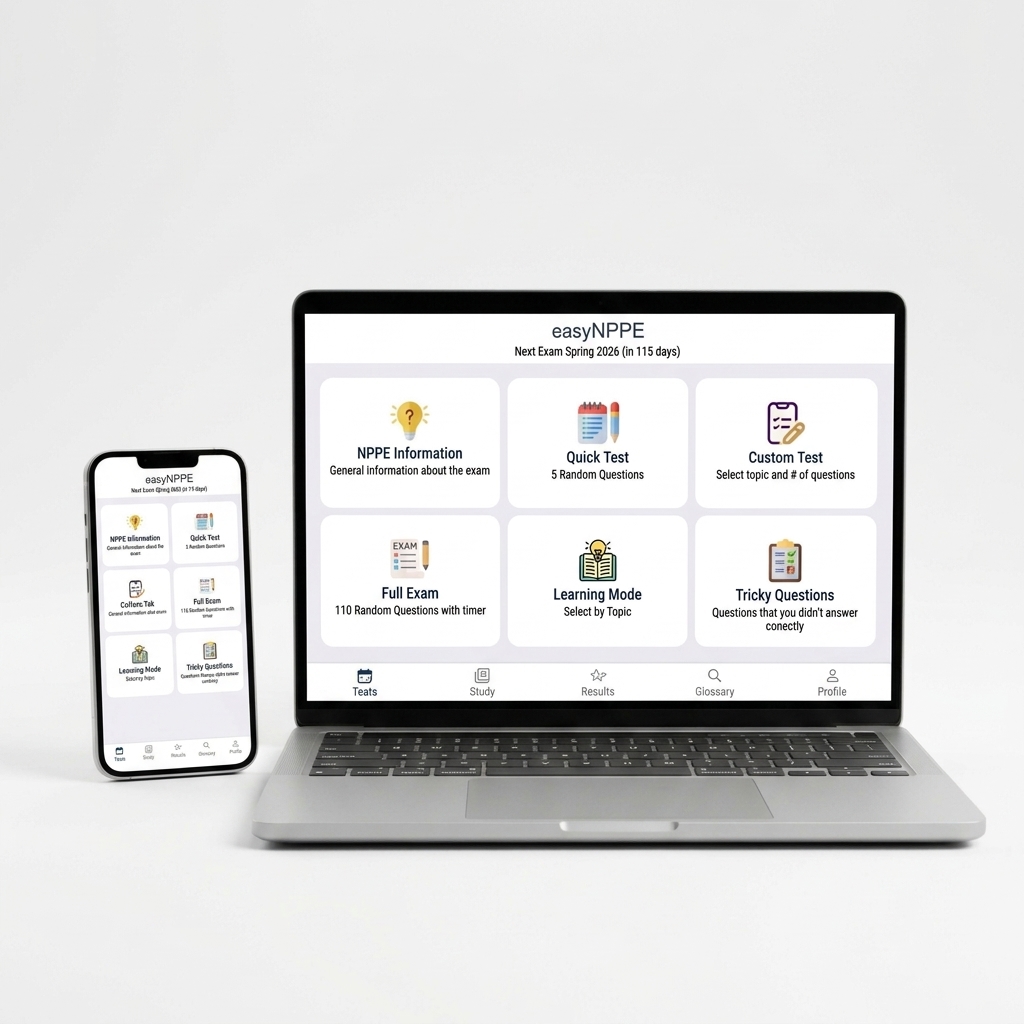
Thousands of candidates have used easyNPPE to prepare for the National Professional Practice Exam (NPPE). We asked them: what do you wish you had known before exam day? Here is a selection of what they said.
1. "I kept second-guessing myself on questions where two answers seemed right."
"The worst part was questions where two answers both looked right. I'd pick one, change it, then change it back. Once I started doing practice questions on easyNPPE I realized the trick is spotting which answer is 'most correct,' not just correct. By exam day that was second nature."
Takeaway: When two answers seem correct, your first instinct is usually right. Flag it, move on, and come back only if you have time.
The NPPE often has options that are partially correct. The exam tests whether you can identify the most correct answer. Practicing this before exam day makes a big difference.
2. "I did not realize how much of the exam is about knowing who is responsible for what."
"I thought it was going to be mostly ethics stuff. Nope. So many questions about regulatory structure, like who investigates complaints, what's the difference between a licence holder and a permit holder, when can a regulator actually suspend someone. I barely read those chapters because they were so dry. Definitely paid for that."
Takeaway: The regulation and governance sections feel boring in the textbook, but they are heavily tested. Do not skim them.
These topics do not come up in engineering coursework and the textbook chapters feel bureaucratic, but the exam asks very specific questions about them.
3. "I could explain every concept but I kept getting tripped up by how questions were worded."
"I spent six weeks on the textbook, random PDFs, YouTube videos. Still felt lost. A colleague recommended easyNPPE so I switched to that. Three weeks later I wrote the exam and passed. Wish I'd just started there."
Takeaway: Scattered prep wastes time. A focused study guide paired with practice questions gets you ready faster than endless reading.
A structured approach with a concise study guide and practice questions that test application cuts prep time dramatically compared to piecing together scattered resources.
Want to see how NPPE questions actually feel? Try real exam-style scenarios for free. You might be surprised.
Try for free4. "I finished with 20 minutes to spare because I did not overthink."
"Everyone said time would be tight but it wasn't bad for me. I'd done a bunch of timed practice exams on easyNPPE so I had a rhythm going in. Read the scenario, cross out two wrong ones, pick between what's left, next. Finished with 20 minutes to spare."
Takeaway: Time pressure is only a problem if you have not practiced under timed conditions. Build the rhythm before exam day.
At roughly 1 minute 22 seconds per question, you cannot afford to deliberate. Timed practice exams build a natural pace, and the elimination technique (narrowing four options down to two) is the single most effective time-saver.
5. "The concepts that seem simple are the ones that tripped me up."
"I was sure I knew what conflict of interest meant. Then a practice question asked about perceived conflict versus actual conflict and I froze. Same with negligence vs gross negligence. Glad I caught those gaps on easyNPPE and not on the real thing."
Takeaway: Pay close attention to concepts that seem similar. The exam deliberately tests the distinctions between them.
These subtle distinctions, like duty to report versus duty to warn, are where most marks are lost.
For a detailed walkthrough of how to approach ethical dilemma questions, see our guide on how to tackle complex NPPE ethical dilemma questions.
6. "Watch for the word 'first.' It changes the entire answer."
"I kept getting scenario questions wrong and couldn't figure out why. Then I noticed something. A lot of them ask what you should do 'first' or 'immediately.' All four answers are things you'd eventually do, but only one is the right first step. Once I started watching for that word everything changed. Pretty sure I spotted it at least ten times on the real exam."
Takeaway: Read the question carefully. "What should you do first" and "what should you do" have different correct answers. The exam uses this constantly.
This is one of the most reliable patterns on the NPPE. When a scenario asks what you should do first, the answer is almost always the most direct, immediate action: speak to the person involved, stop the unsafe work, or report to your regulator. The options that describe longer-term solutions (review the policy, consult legal counsel, document everything) are correct actions but not the first action.
7. "I almost did not bother with the glossary. That would have been a mistake."
"Terms like standard of care, fiduciary duty, vicarious liability kept coming up in practice and I was fuzzy on all of them. Sat down with the glossary on easyNPPE for two hours and after that those questions were easy. Probably worth 10 extra marks for two hours of work."
Takeaway: The NPPE has its own vocabulary. Investing a couple of hours in the glossary pays off more than rereading chapters you already know.
If you are guessing at what a term means mid-question, you are already at a disadvantage. A focused review of key terms is one of the highest-return study activities you can do.
Know every term before exam day. easyNPPE includes a 180+ term glossary covering every key concept on the NPPE syllabus.
Start practicingThe common thread
The pattern across every story is clear: the candidates who struggled were the ones who assumed knowing the material was enough. The ones who passed comfortably were the ones who practiced applying it, learned the precise terminology, and built a rhythm for answering under time pressure.
The NPPE does not reward the candidate who read the most pages. It rewards the candidate who can read a scenario, identify what is actually being asked, and pick the best answer in under 90 seconds. That is a skill, and like any skill, it gets better with practice.
Start Practicing for FREE
450+ practice questions with detailed explanations, a full study guide, glossary, and progress tracking by topic. Free tier available, no credit card required.
Start Practicing for FREE