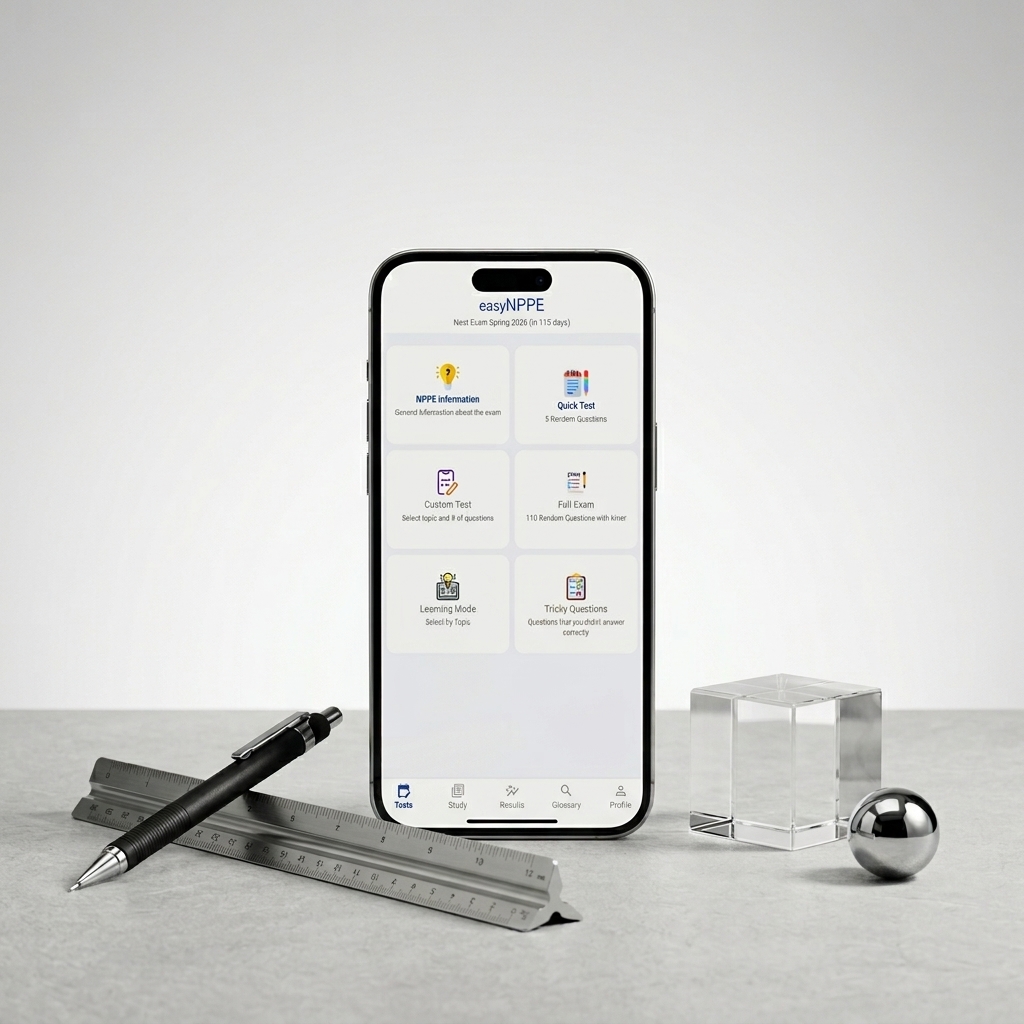
Welcome to the easyNPPE blog with free NPPE exam strategies to pass, where we aim to help aspiring engineers and geoscientists excel in their National Professional Practice Exam (NPPE). The NPPE is a crucial step for those seeking to become a licensed engineer or geoscientist in Canada, as it evaluates your understanding of legal, ethical, and professional practice aspects of the engineering and geoscience professions.
easyNPPE gives you 5 free practice questions with detailed explanations inside the app, no payment required. In this post, we'll walk through one of them in depth: a challenging ethical dilemma with a step-by-step analysis of the best answer.
Want more questions like this one? Start practicing for free with real NPPE-style questions and detailed explanations, no payment required.
Try for freeMastering NPPE Questions, Ethical Dilemma
Please note that the scenario below is non-factual and created for practice purposes only.
A licensed engineer discovers that a colleague has intentionally misrepresented her qualifications and experience to secure a high-profile project. The project is currently underway, and the licensed professional is concerned about serious potential risks and consequences of this misrepresentation. What should the licensed professional do in this situation?
In-Depth Analysis

Ethical dilemma questions are among the most challenging on the NPPE. Rather than testing memorized facts, they test your ability to reason through competing professional obligations. Use this three-step method:
Reporting to management alerts the organization to potential risks and holds the colleague accountable internally. However, management does not have the authority to address the broader implications for the profession and the public. Internal escalation alone is insufficient when serious potential risks are involved.
While this may feel like the considerate approach, it fails to address the potential risks to public safety. It also places the responsibility of rectifying the situation back in the hands of the colleague, who has already demonstrated unethical behavior. Given the serious potential risks stated in the question, private confrontation is not adequate.
This is the strongest option. Reporting to the professional regulatory body ensures the matter is investigated by the appropriate authority, one with the mandate to protect public safety and maintain professional standards. This approach holds the colleague accountable and addresses both the immediate risk and the integrity of the profession.
This option ignores the root cause of the problem. Waiting for issues to arise before acting does not protect public safety proactively, fails to address the misrepresentation, and does not hold the colleague accountable. This is a reactive approach when the situation calls for decisive action.
Why Option C is the Best Answer
It's important to remember that in some cases, escalating the issue internally (option A) might be the preferred approach, especially if the organization has a well-established system for addressing ethical concerns. However, the presence of serious potential risks highlights urgency that necessitates more decisive action through the appropriate regulatory channel.
Given the potential risks to the project and public safety, reporting the colleague to the professional regulatory body becomes the most effective way to protect the public interest and maintain the integrity of the profession. The emphasis on potential risks underscores the importance of addressing the issue promptly through proper channels, rather than relying solely on internal escalation.
Practice more ethical dilemmas like this one. easyNPPE's 450+ questions include detailed reasoning for every answer.
Start for freeConclusion
By carefully evaluating each option and considering the ethical, legal, and professional implications, you can navigate challenging ethical dilemmas on the NPPE exam with confidence. Always look for keywords in the question, phrases like "serious potential risks," "public safety," or "urgent" often signal that a more decisive action is required.
easyNPPE is designed to teach you exactly this approach. By practicing with scenario-based questions and reading the detailed explanations, you'll build the reasoning skills needed to evaluate every option, not just recognize the right answer, and apply them confidently on exam day.
Start Practicing for FREE
Real exam-style questions with detailed explanations and a full Professionalism study guide. Zero commitment, no payment info required.
Start Practicing for FREE